
Locate Lawrence County Court Records
A good request begins with two facts: the case number and the court office. Missing either? Search the county portal or call the likely clerk before asking for copies. The courthouse, the working clerk offices, the Archives, and the municipal courts are separate Lawrence County access points. A precise route saves time. It also helps the clerk tell a docket sheet apart from a signed order, minute entry, recording, or the full public file. Say plainly what you want. Are you inspecting the record, buying a plain copy, or requesting certification? Each answer changes the process and the cost.
Lawrence County Court Record Requests
Start online when the case sits in Circuit Court, General Sessions, or Chancery. The county-linked portal can yield a case number. It can point to the likely office, though its own terms say the online information is not the official record. For the file itself, contact the Circuit Court Clerk for Circuit, General Sessions, or Juvenile matters. Chancery belongs to the Clerk and Master. You can request at the counter or call for routing. You can also mail after the office confirms its process. Tennessee public-record guidance lets an office offer other methods too. These include fax, email, or online submission. Lawrence County publishes no standard court-record form, so ask. Check whether a public inspection terminal or a paper docket exists. Ask the office directly.
- Identify the court office, case number, filing year, and exact item needed.
- Call the custodian to confirm access, format, certification, and accepted delivery method.
- State whether inspection, paper copies, scans, or certified copies are wanted.
- Ask for the fee and postage estimate before the office copies material.
- Keep the clerk response and certification with any record received.
Lawrence County Records Have Custodians
Custody is split, and that is the key local fact. Tommy Lee Kidd serves as Circuit Court Clerk. The office sits at 240 W. Gaines Street, NBU #12, Lawrenceburg, reachable at 931-762-4398, with weekday hours from 8:00 a.m. through 4:30 p.m. Kristy Gang is the Clerk and Master at NBU #13. Her phone is 931-766-4182, with the same published hours. City clerks keep municipal traffic and ordinance files. The County Clerk handles titles, licenses, passports, and other county work, not court cases.
Lawrence County Circuit Court Clerk
240 W. Gaines Street, NBU #12
Lawrenceburg, TN 38464
931-762-4398
Circuit, General Sessions, and Juvenile divisions
Lawrence County Clerk and Master
240 W. Gaines Street, NBU #13
Lawrenceburg, TN 38464
931-766-4182
Chancery docket administration and permanent records
The county directory and department pages show some conflicting contact details. Verify the office and number before you send a request or make the trip.
Kinds of Lawrence County Records
A court case file can hold far more than the docket index shows. Ask for the precise source you need. A docket sheet or minute entry may show procedural activity only. A signed judgment or order is the court's operative ruling. An official recording falls under a separate Tennessee rule. A certified copy bears the clerk's authentication. That is what makes it official.
- Docket sheets and case indexes
- Filed motions, pleadings, and orders that are public
- Minute entries and signed judgments
- Official electronic recordings when Rule 26 permits a copy
- Certified or plain copies of accessible material
Chancery records can involve property, contract, probate, divorce, guardianship, conservatorship, or other equity matters. Their appearance in the portal does not make every filing public.
Narrow Lawrence County Record Requests
Narrow your ask and you will get records faster. Clerks are not required to build new lists. They will not sort through files as a research service. The Tennessee Comptroller tells requesters to describe each record clearly, so that the office can find it. So put the basics in writing: your name and contact details, a Tennessee address if you invoke the Tennessee Public Records Act, the court office, the case number, the filing year, and the exact record or date range you want. That one step prevents most delays.
The Lawrence County open-records page posts no detailed local policy. No coordinator name appears there. No request form appears either. Start with the clerk whose office made the filing. If that office treats your letter as a TPRA request, simply ask who coordinates records requests now and ask for a copy of the current policy.
For the county's own request landing, the official open-records source shows where Lawrence County receives public-records requests.
That page confirms a county access route. It does not replace the clerk who holds the court file.
Lawrence County Records: What They Contain
The table below describes records worth requesting, not portal fields. The clerk can say which item exists and which parts are public.
| Docket sheet | Entered events, filings, settings, and dispositions maintained for the case. |
|---|---|
| Minute entry | The clerk’s official notation of court action. |
| Judgment or order | The signed ruling and its terms, subject to access limits. |
| Filed paper | A named motion, pleading, or exhibit if open to inspection. |
| Recording | An official electronic recording available under Rule 26 and its fee rules. |
| Certification | The clerk’s authentication of the supplied copy. |
Never assume an online status equals the signed judgment. Tennessee Rule of Civil Procedure 58 governs entry of judgment and docket notation. The filed order and the service record matter most.
Older Lawrence County Court Records
The Lawrence County Archives preserves county material dating from 1818 through the mid-1990s. The holdings include court, probate, will, marriage, deed, tax, and map records. Recent records stay with the office that made them. When you contact Archives, give the date range. Also give the original court or office, and any book, page, or case identifier. The official Archives page documents this Lawrence County records channel.
Archives is a route for old records, not a substitute custodian for a current case.
Unsure where the file sits? Ask the current clerk whether it was transferred before sending a second request to Archives.
Lawrence County Copy Fees and Certification
The clerks publish no complete current fee schedule for certified dockets, exemplification, transcripts, or ordinary case-file copies. Ask for a total before work begins. Keep certified copies distinct from portal printouts. The Archives schedule and the statewide model amounts described by the Comptroller do give reference points.
| Item | Verified amount or rule |
|---|---|
| Archives paper copy | $0.15 per page |
| Archives certification | $1 |
| Archives scan | PDF or JPG often has no charge |
| Archives mail | Exact postage |
| State model copy rate | $0.15 black-and-white; $0.50 color for standard pages |
| Official recording duplicate | Rule 26 lists $50 simultaneous and $100 later per disc, with exceptions |
Inspection generally carries no charge unless authorized. Copy charges must be reasonable under the applicable policy and law.
Tennessee Access for Lawrence County
Tennessee's open-records law has a quirk worth knowing. The Comptroller's TPRA guidance walks through who counts as a requester. It also covers how specific a records request must be, and how inspection and copying work. The statutory right belongs to Tennessee citizens only. Still, an agency can open its records wider if it wishes. Bring government photo identification and an address, since a custodian may ask for both.
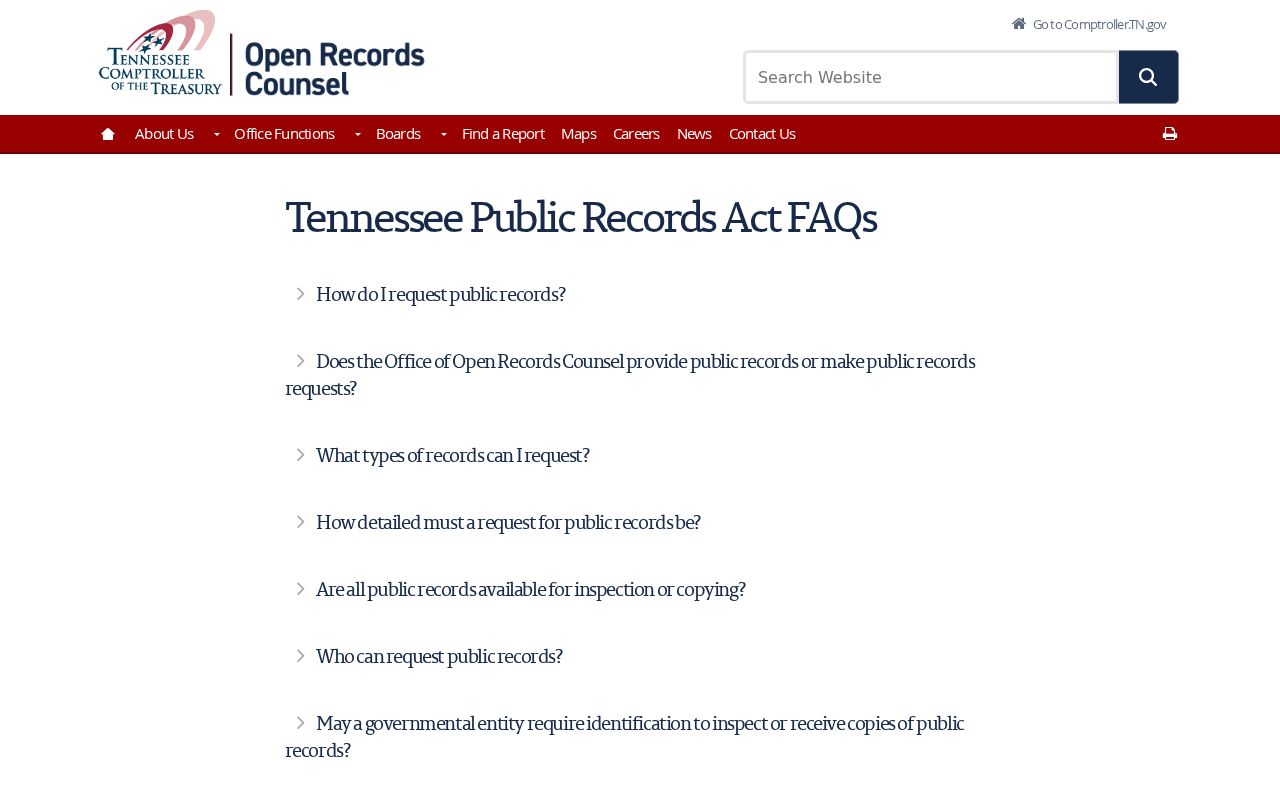
That statewide framework gives you a fallback if a local request stalls. Still, the court file itself answers to court rules and the clerk where the case was filed.
Lawrence County Court Record Access Rules
Court records in Tennessee start from a presumption of openness. Supreme Court Rule 34 lets anyone inspect them. Carve-outs exist for confidential records, sealed or protected material, drafts, and internal case-management files. Civil filings get their own rule. Rule 1A presumes civil records are open, but a judge may seal them when a serious and substantial interest outweighs access and nothing less restrictive would work.
Juvenile, adoption, child-welfare, protected victim, medical, psychological, grand-jury, confidential-informant, and some investigative material may be withheld or redacted.
When you hit a sealed file, ask a narrower question. A non-confidential order, a public docket entry, or a redacted copy may still be available. The clerk and the court make that call under the governing law and any sealing order.
Federal Records Beyond Lawrence County
Federal cases sit outside the Lawrence County clerk's office entirely. Lawrence County falls in the Middle District of Tennessee, Columbia Division. That Columbia courtroom is staffed only while court is in session. Filings and mail go to Nashville instead. For the federal docket itself, PACER and CM/ECF are the tools. The official Middle District CM/ECF information page lists the details.
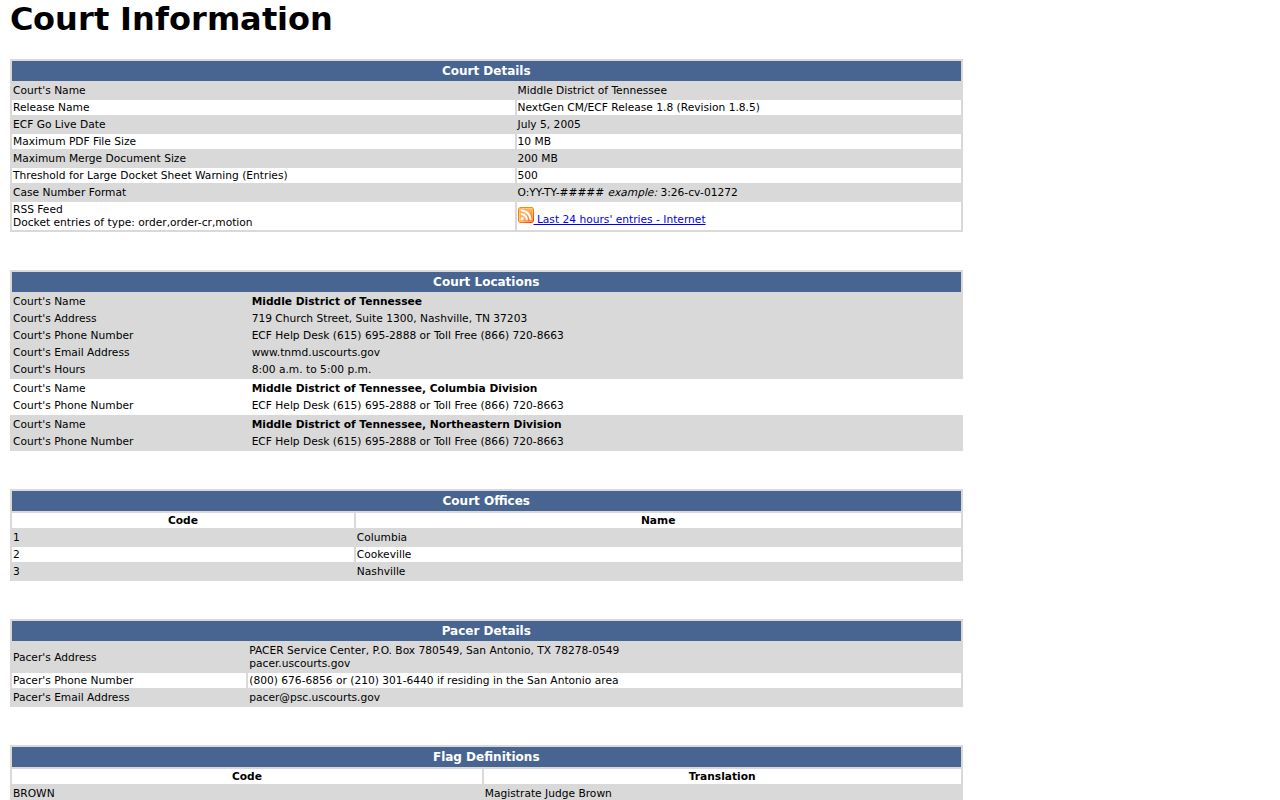
This federal system stands apart from county trial records and from Tennessee's appellate Public Case History.