
Lawrence County Criminal Docket Searches
The county's own entry point is the Lawrence County Online Court Records System. Choose Criminal, then pick Circuit Court or General Sessions. You can search by party name or case reference. A four-digit filing year works, or a case number. The help screen suggests a formatted number like 99GS1-2023-CR-12345 works best if you enter only its final numeric part. A quick human-verification check guards Find Now.
With no case number, type the full name. The portal reads only the first ten words. It accepts quoted phrases, and forgives small spelling slips in longer terms. There is no filter for charge, judge, attorney, date range, or outcome. And a blank result is not proof the case is absent.
- Open the county-linked portal and choose Criminal.
- Select Circuit or General Sessions based on the case stage.
- Enter the full name, case reference, or final numeric portion of the case number.
- Add the filing year only when it is known.
- Confirm any key entry with the Circuit Court Clerk.
Lawrence Criminal Portal Limits
The portal terms say it plainly: online information is not the official court record. It can be incomplete or out of date. A search result, in other words, is not certified proof of what a docket holds. Charges, bond, counsel, settings, pleas, sentences, and balances all deserve a check at the source.
Treat whatever you find as a locator. Write down the case number and the court office. Then ask the clerk for the docket, the minute entry, a signed judgment, or a certified copy. The portal clerk-contact screen shows how the offices are routed.
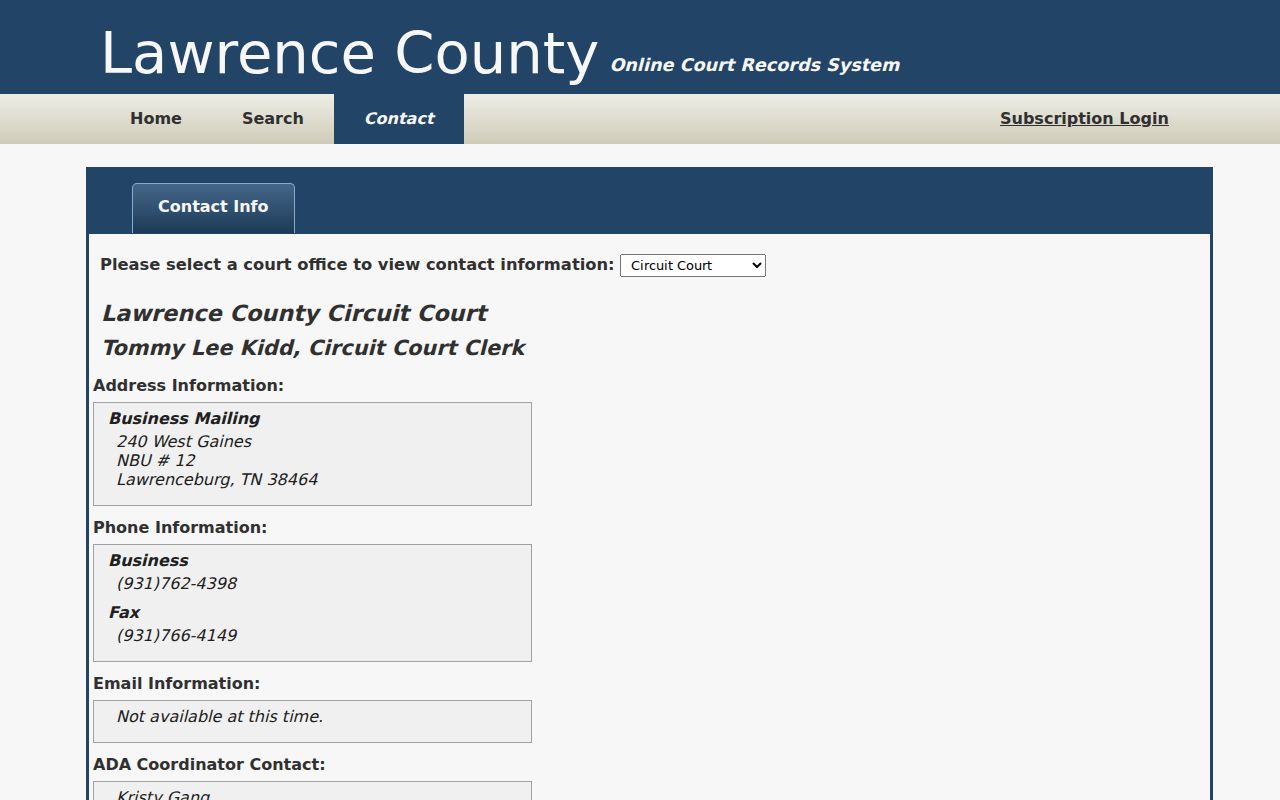
Picking the right court is half the search, as the contact view makes plain. The portal's linked accuracy notice offers the same caution about trusting an entry on its face.
That notice is why a result should always end in clerk verification. Beyond the portal, you can visit the clerk counter, call, or mail a narrow request naming the court, the case number, the filing year, and the exact record you want. Ask too whether a public terminal exists, since the clerk does not advertise one online. A fax line, 931-766-4149, is listed. Confirm the clerk accepts fax requests before sending one.
Criminal Dockets: What They Show
A criminal docket is the clerk's ordered log of everything filed and heard in a case. Entries may point to filings, settings, and an outcome. But a public result may not show every field, so treat nothing as final on its own. Ask for the official docket or the minutes first.
| Case number | The identifier used to locate the file and distinguish similarly named matters. |
|---|---|
| Court office | Circuit or General Sessions, which controls the right clerk and case stage. |
| Setting | A scheduled event that must be confirmed with the clerk because no public calendar was verified. |
| Disposition | The reported outcome; compare it with the signed judgment or minute entry. |
| Filed record | The motion, order, or judgment itself, if public and available from the custodian. |
Lawrence Criminal Workload Context
For scale, the Tennessee AOC report for fiscal 2024-25 counts 916 Lawrence criminal filings and 1,113 dispositions in its reported categories. Those figures count events. They are not distinct people or case numbers. One docket can hold dozens of entries, so the totals cannot tell you whether any single case is still open.
Within those totals, the report lists 561 guilty pleas as charged, 369 dismissals or nolle prosequi entries, and 88 pleas to a lesser offense. "Nolle prosequi" simply means the prosecution declined to go forward. That applies to that charge at that time. None of these numbers tells you how any named Lawrence County case ended. For that, you need the record itself.
Criminal Case Stages on the Docket
Where a case sits depends on its level. A misdemeanor can stay in General Sessions start to finish. A felony may open there for a bond matter or a preliminary hearing, then shift to Circuit Court after indictment. Each setting is one step, not automatically the trial date. A reset only moves the calendar. It does not dismiss anything.
Docket flow: Filing → Arraignment → Pretrial → Plea or Trial → Disposition → Sentencing
For a final result, request the signed judgment and its docket notation. Tennessee Rule of Criminal Procedure style aside, Tennessee Rule of Civil Procedure 58 governs judgment entry in civil matters, and criminal proof deserves the same rigor. Take it from the clerk-held final record, not a shorthand portal status.
Lawrence County Recovery Court
The state court-contact list names the 22nd Judicial District Recovery Court, a Circuit-level program serving Giles, Lawrence, Maury, and Wayne counties. A district contact sits in Lawrenceburg. The state publishes no specialty-calendar search or participant list for it.
Older official material described a Lawrence program that began in General Sessions. So confirm with the clerk. Ask which court level and county setting apply to a given referral. And never assume program participation is public. A related criminal case may be, but that does not make this one so.
Lawrence County Criminal Docket Courts
Lawrence County's court overview assigns misdemeanors carrying up to 11 months and 29 days, bonds, and felony preliminary hearings to General Sessions. Tennessee Highway Patrol tickets land there too. Felonies carrying more than one year, plus other criminal matters assigned there, belong to Circuit Court. Both county dockets run through Circuit Court Clerk Tommy Lee Kidd.
City court keeps municipal traffic and ordinance cases. Do not fold those into a county criminal search. Juvenile matters require special access review. If the offense level is unclear, hand the clerk the case number and ask which office holds the file.
Verify Lawrence Criminal Court Dates
The clerk posts no downloadable daily calendar for Lawrence County criminal cases. So treat any date you see as provisional. Run your docket search first, then pick up the phone. The Circuit Court Clerk, reached at 931-762-4398, can confirm the next setting, the courtroom, and whether a judge has already moved the hearing. The office sits at 240 W. Gaines Street, NBU #12, Lawrenceburg, and keeps weekday hours of 8:00 a.m. to 4:30 p.m.
A setting is not always a trial. Ask whether the entry is an arraignment, preliminary hearing, pretrial conference, plea date, trial, or sentencing date.
Need an interpreter or other accessible accommodation for a Lawrence County court date? The county ADA page asks that requests come with lead time, and it promises no surcharge.
Access Rules for Criminal Dockets
Tennessee Supreme Court Rule 34 presumes court records are open to inspection. But it carves out material the law makes confidential, sealed or protected filings, drafts, and internal case-management work. Some categories draw firmer limits. Juvenile records, child-welfare files, protected victim information, grand-jury material, confidential informants, and active investigations all qualify.
How do you actually get a public record? Ask the custodian, either to inspect a document or to request a specific one. The Circuit Court Clerk takes requests in person or by phone. A narrow mail request works too. It should name the court, case number, and year, plus the exact docket sheet, minute entry, order, or judgment you want. Call ahead, since the clerk decides whether fax or another delivery method is acceptable.
Key rules: Rule 34 governs court-record access. Tennessee Code sections 10-7-503 and 10-7-504 address public-record access and confidential categories. A clerk or judge decides access under the rule, statute, and any sealing order.
Request a Lawrence Criminal Record
A tight request gets answered faster. Say up front whether you want to inspect a record, get a plain copy, or need a certified copy. Then name the court, Circuit or General Sessions, along with the case number and filing year. Point to the exact docket sheet, minute entry, judgment, sentence, or order. Missing the number? Give just the full name needed to locate the case, no more. Always ask about fees and delivery options before placing the order.
State guidance lets agencies accept record requests through whatever channels they offer. That could be in person, by phone, fax, mail, email, or online. Lawrence County publishes no standard court-record request form. So go straight to the clerk where the case started. Confirm which route that office accepts. Two frameworks govern you here. The Tennessee Public Records Act gives citizens of the state a right to records. It can require proof of address, while court files also answer to Rule 34 and any seal or confidentiality statute that applies.
Older material is a different errand. The Lawrence County Archives holds historic volumes and loose files, not current criminal dockets. So check whether your item ever transferred there before making the trip. Its fees are $0.15 per page, $1 to certify, often no charge for scans, and exact postage on mailed copies. Remember those are Archives prices, not a Circuit Clerk fee schedule.